
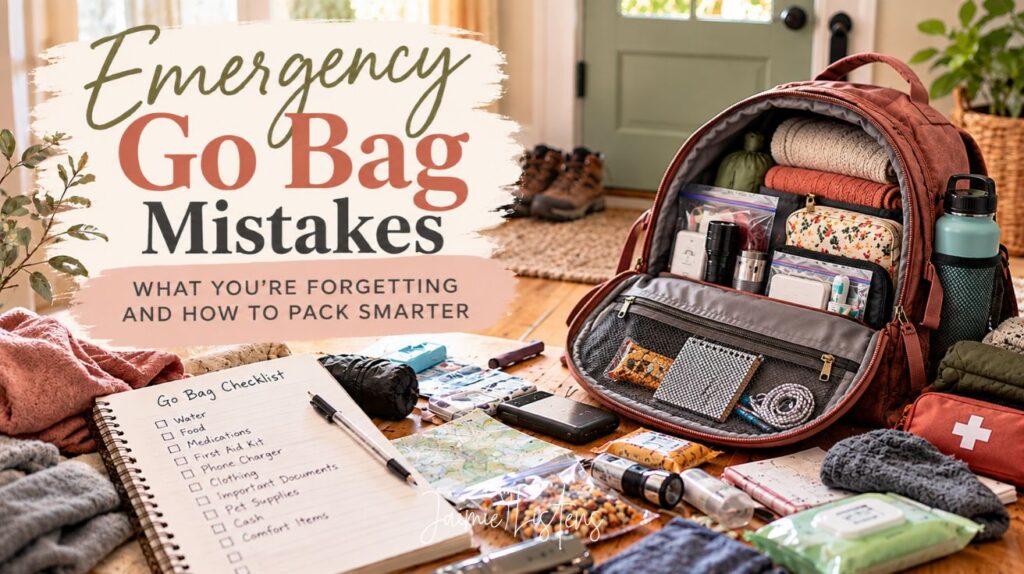
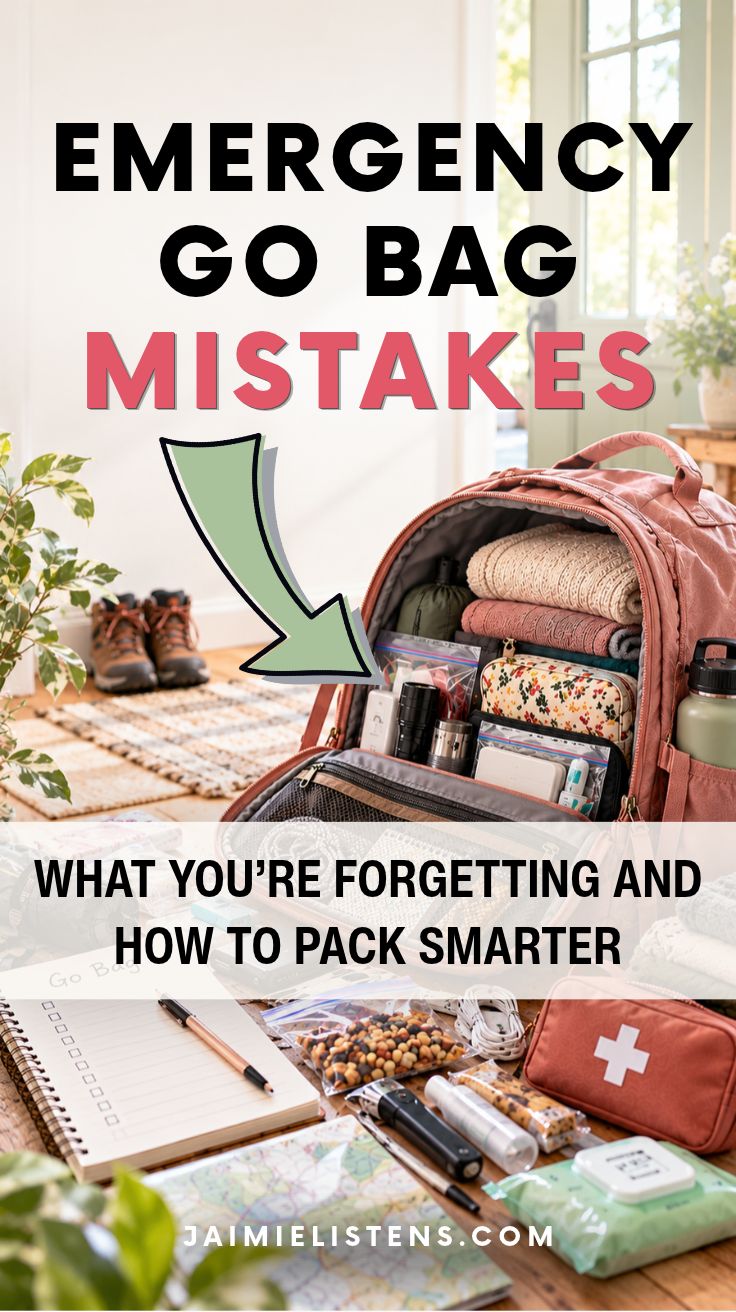
You packed your emergency go bag, checked off all the essentials, and you’re ready for anything. Right?
Well, not so fast, Pack-y McPackface.
Some of the biggest emergency go bag mistakes have nothing to do with forgetting a flashlight or an extra pair of Hallmark themed underwear. Let’s make sure your bag is actually helping you prepare for an emergency instead of creating a whole new set of problems, because that’s what your MIL is for.
So, what Are the Most Common Emergency Go Bag Mistakes?
Having an emergency go bag packed and ready doesn’t necessarily mean you’re prepared to use it. Even a bag filled with recommended emergency supplies and the finest chocolate can leave you scrambling if you’ve overlooked a few important details.
Here are three common emergency go bag mistakes:
- Forgetting important documents and information. Food, water, and first-aid supplies are important, but so are the documents and information you’ll need during and after an emergency.
- Packing too much. Trying to prepare for every possible situation can leave you with a bag that’s too heavy or impractical to carry.
- Packing your bag and forgetting about it. Expired supplies, dead batteries, and outdated information can turn a well-stocked emergency bag into a nasty surprise when you need it most.
But there’s a fourth mistake that might really surprise you. It has nothing to do with what’s inside your bag, and it could undermine all your careful preparations.
Let’s look at how to avoid these mistakes and pack a smarter emergency go bag.
Mistake #1: Forgetting Important Documents and Information
You’ve packed food, water, medications, and the best emergency supplies to survive a zombie apocalypse. But what about the important documents and information you’ll need after you’ve made it to safety?
If you’re forced to evacuate your home, you may need identification, insurance information, medical records, financial information, and emergency contact numbers. Those things aren’t nearly as exciting as survival gadgets, but they can make life considerably easier when you’re trying to put everything back together.
Here’s how to avoid this mistake:
- Identify your essentials. Figure out which documents and information you’d need if you couldn’t return home for several days or longer.
- Keep secure, accessible copies. Consider protected digital copies and appropriately secured physical copies of critical information. Avoid leaving sensitive originals or unprotected financial information in an unattended bag.
- Don’t rely entirely on your phone. Batteries die, phones get lost, and internet access isn’t guaranteed. Have a backup way to access essential contact information.
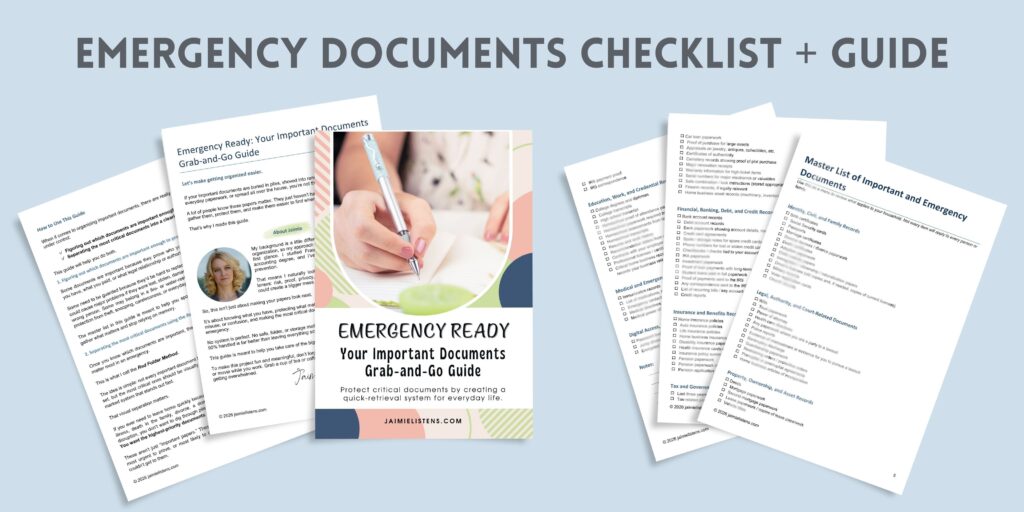
Not sure which documents belong on your list?
My free Important Documents Checklist will help you identify and organize the paperwork and information you may need during an emergency, so you’re not trying to remember your insurance policy number while standing in a hotel lobby.
Mistake #2: Packing Too Much
When you’re preparing for an emergency, it’s tempting to pack everything you might possibly need. Unfortunately, there’s only so much room in a backpack, and your back has opinions about how much weight it wants to carry.
An emergency go bag that’s too heavy to carry comfortably could become a problem if you have to evacuate on foot, climb stairs, or walk farther than expected.
Here’s how to pack smarter:
- Prioritize necessities. Start with the supplies you genuinely need, including water, essential medications, appropriate clothing, and basic safety items. Add extras only if you have room and can manage the weight.
- Choose multipurpose items. A lightweight jacket that provides warmth and rain protection may be more useful than packing separate clothing for every possible weather condition.
- Consider your transportation. If you’re evacuating by car, you may be able to bring additional supplies. But keep your essential go bag manageable in case you have to leave the vehicle behind.
- Test your bag. Put it on and walk around with it. Try carrying it up and down stairs. If you’re exhausted after five minutes, imagine carrying it for an hour.
Remember, the goal isn’t to pack the most stuff. It’s to pack what you can realistically use and carry.
A little thoughtful planning now beats discovering you’ve packed a 40-pound monument to your own preparedness ambitions.
Extra tip: Black full-length yoga pants are a good choice for your bag. Lightweight, can be slept in, hiked in and can even look like dress pants with a cute top. If you’re a guy, you can pick green and live out that Peter Pan fantasy.
Mistake #3: Packing Your Go Bag and Forgetting About It
Congratulations! You’ve packed your emergency go bag, zipped it up, and tucked it away somewhere safe. Another thing checked off your to-do list!
Unfortunately, emergency supplies aren’t necessarily a pack-it-and-forget-it proposition.
Food expires, batteries lose their charge, medications change, and clothing that fit perfectly two years ago might now be better suited for your neighbor’s teenager.
Here’s how to keep your emergency go bag ready:
- Check expiration dates. Inspect food, medications, and other supplies with limited shelf lives. Replace anything that’s expired, damaged, or no longer appropriate.
- Test your equipment. Make sure flashlights, radios, and other battery-powered devices still work. Check for leaking batteries or damaged equipment.
- Review personal needs. Update clothing sizes, prescriptions, emergency contacts, and supplies for children, pets, or anyone with special requirements.
- Make it a routine. Set a reminder to inspect your bag every six months, and update it sooner whenever your circumstances change.
Extra tip: Tie your go bag inspection to something you already do twice a year, like changing your clocks or swapping seasonal clothing. That way, you don’t have to remember yet another random household chore.
An emergency go bag is only useful if its contents are still usable when you need them. A few minutes of maintenance now could save you a whole lot of aggravation later.
Mistake #4: Having an Emergency Go Bag but No Evacuation Plan
Here’s the mistake I promised you earlier, and I think it’s the biggest one of all.
You’ve packed an emergency go bag, but you haven’t made an evacuation plan.
Your bag might contain everything you need to survive for three days, but do you know where you’re going? How you’ll get there? What you’ll do if your first route is blocked or your intended destination isn’t available?
And what about the other people in your household? Does everyone know what to do if you’re not home when an evacuation order comes?
An emergency go bag is an important tool, but a bag full of supplies isn’t an evacuation plan.
Here’s how to avoid this mistake:
- Choose your destinations. Identify somewhere you can go and at least one backup option.
- Plan your routes. Consider different ways to reach safety, including what you’ll do if roads are closed.
- Get everyone on the same page. Make sure household members understand the plan, how to communicate, and where to meet if separated.
- Practice your departure. Find out how long it actually takes to gather everyone, collect essential items, and leave.
Ready to Put It All Together?
Knowing what to pack is only one piece of emergency preparedness. Having a workable plan for getting yourself, your loved ones, and your essential belongings to safety is another.
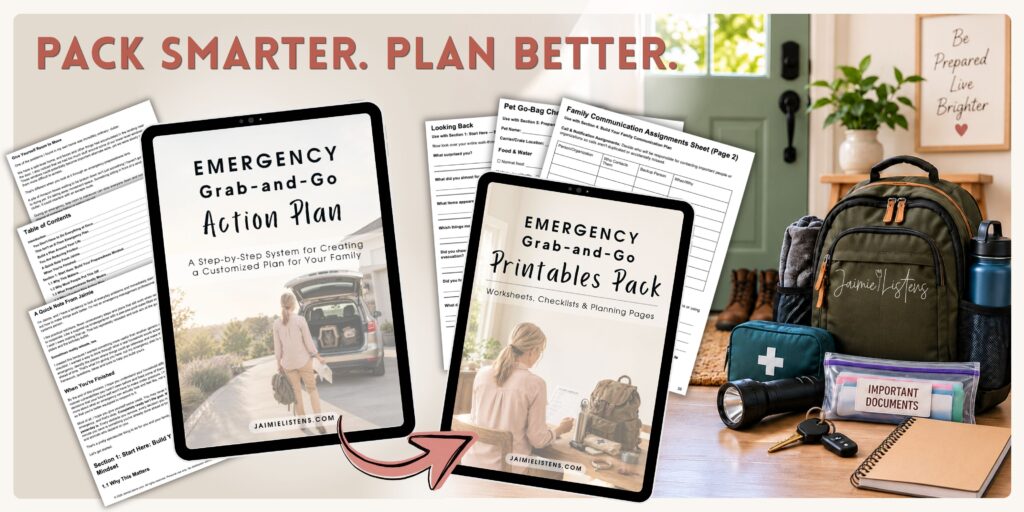
That’s why I created the Emergency Grab-and-Go Action Plan.
Instead of handing you another generic list of survival supplies, this guide helps you think strategically about your own circumstances, identify potential problems, and create an evacuation plan that works for your household, your resources, and your needs.
The package includes an eBook with over 100 pages of practical guidance and a 60-page companion pack featuring 15+ printables with instructions. The printables correspond to sections of the eBook, so you can work through your preparations at your own pace, rather than preparing for whatever adventure Crocodile Dundee might have in mind.
And because everyone’s needs are different, you can print what you need and leave the rest. No wasting paper on things that don’t apply to you.
Because the best emergency plan isn’t the one with the most supplies. It’s the one that actually works for you.
Final Thoughts on Emergency Go Bag Mistakes
You don’t need a backpack stuffed with expensive survival gadgets or enough supplies to treat a raging case of just-in-case-itis. (No shame intended – I’ve had it too, sis.) You need a bag you can actually carry, supplies you can actually use, and an evacuation plan that makes sense for your life.
And remember that mother-in-law I mentioned earlier? Well, sometimes the biggest obstacle to emergency preparedness isn’t the emergency. It’s the people you’re trying to prepare with.
If you’ve got a family member who thinks emergency planning is a waste of time, refuses to cooperate, or makes everything ten times harder than necessary, I’ve got you covered.
Check out my article: Emergency Planning When Your Family Won’t Cooperate: What to Do.
Because surviving the emergency is one thing. Surviving the family meeting about it is another.
Disclaimer: Jaimie is not the great and powerful Wizard of Oz, a lawyer, a doctor, a veterinarian, or a CPA. Nothing you read in my blog is a substitute for professional advice and doing your own good research. Remember that just because someone has credentials doesn’t guarantee their advice is golden or perfect. Put your smart hat on and do your due diligence. Good luck!
AI Disclosure: This post was created with the assistance of AI tools for brainstorming, editing, and organization, which helps me manage chronic pain and physical limitations during long writing sessions. All content is based on my real-life experience and is reviewed and edited by me. Some or all images in this post may be AI-generated for illustration and inspiration. Learn more about how I use AI here.

Leave a Reply