

Some links may be affiliate links. As an Amazon Associate, I earn from qualifying purchases. This post may include AI-assisted content.
If you’ve ever grown raspberries and ended up with a ton of tiny fruit, you’re not alone.
It looks like a good harvest… until you start picking and realize how long it takes just to fill a bowl.
The good news is, you don’t need to work harder. You just need to guide the plant a little differently.
Most people are only missing a few simple adjustments, but they make a big difference. Once you understand how to guide the plant’s energy instead of letting it grow wild, you can grow raspberries that are bigger, easier to pick, and actually worth the effort.
How to Grow Raspberries for Bigger Berries (Quick Answer)
If you want bigger raspberries, let new canes grow freely through fall, leave them standing through winter, then cut them back in early spring right after they start budding.
That timing shifts the plant’s energy into fewer berries, which makes them noticeably larger and easier to pick.
This works best when you also keep the plant thinned, supported, and well-fed, but that one timing change alone can make a big difference.
Next, I’ll show you the exact order I use + the other mistakes that shrink berries.
Here’s the Part Most People Miss About Growing Raspberries
Raspberry plants don’t just grow randomly. They plan ahead.
By the time you see buds forming in early spring, the plant has already “decided” to store up enough energy for that long cane.
When you cut it back at that point, you’re not just pruning. You’re redirecting energy the plant already set aside.
That’s the part most people miss. And it’s why this works so well.
How to Grow Raspberries for Bigger, Better Berries (Not Just More Berries)
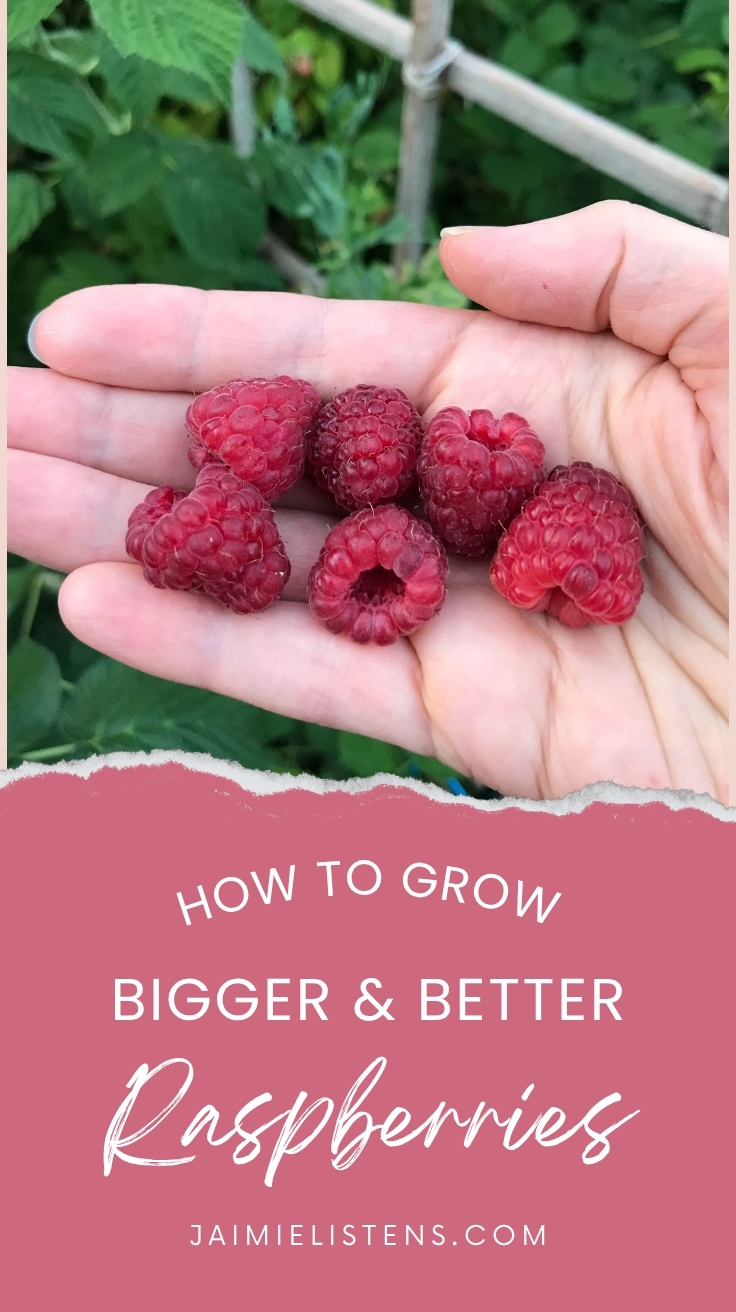
Most people growing raspberries focus on getting more growth.
More canes. More berries. More everything.
It makes sense. A full patch looks productive, but more isn’t always better.
When a raspberry plant spreads its energy across too many canes and too many berries, everything gets smaller.
That’s when you end up with:
- lots of tiny fruit
- uneven ripening
- and a harvest that takes forever to pick
What you actually want is:
- fewer strong canes
- good airflow
- and focused energy
That’s what leads to bigger berries that are easier to pick and actually worth your time.
Pruning Raspberries for Bigger Berries Starts With Timing
Pruning raspberries isn’t just about cutting them back. It’s about when you do it.
If you cut too early, the plant hasn’t stored up much energy yet. If you don’t cut at all, it spreads that energy across too much growth. Neither one gives you the result you want.
The sweet spot is early spring, right when you start to see buds forming. At that point, the plant has already “decided” how much energy it needs for that full cane. When you cut it back then, you’re changing the plan after the energy has already been stored.
That’s what shifts the plant from producing more berries to producing better ones.
You can cut your canes anywhere from about waist to chest height. I keep mine a little taller so they double as a bit of a privacy hedge… especially from the very enthusiastic, Dennis-the-Menace-wannabe neighbor kid who likes to yell over the fence, “Hey lady! Hey, laaaady!”
Use what works for your space.
The Raspberry Patch System I Use for Bigger Fruit and a Better Harvest

Start here
If you want the full picture, this is the system I use from season to season. Nothing complicated, but the order matters.
I let new canes grow freely through the fall and leave them standing through winter. In early spring, I wait until I see buds forming, then I start by clearing out all the old dead wood so I can actually see what I’m working with.
Once everything is cleaned up, I cut the remaining canes back to about waist to chest height. After that, I tie them up with string or secure them to a simple trellis to keep them upright and easy to manage.
From there, I thin things down to about two to three strong canes per plant. I remove the weak ones, the skinny ones, and the shorter late-growth canes that didn’t have time to fully develop.
Once the structure is set, I clean out any debris underneath the plants and finish by adding about an inch of good organic compost around the base.
That combination keeps the plant strong and focused, which is what leads to better fruit.
If you only do one thing
Wait until your canes start budding in early spring, then cut them back.
That’s the step most people skip, and it’s the one that makes the biggest difference in berry size.
What works in real life
Fewer strong canes will outperform a crowded patch every time. Keeping the base clean improves airflow and makes the whole area easier to manage, and a simple layer of compost gives the plant what it needs to actually produce well.
You don’t need anything fancy. Just consistent care in the right order.
My 9-Step Raspberry Prep System (Quick Checklist)
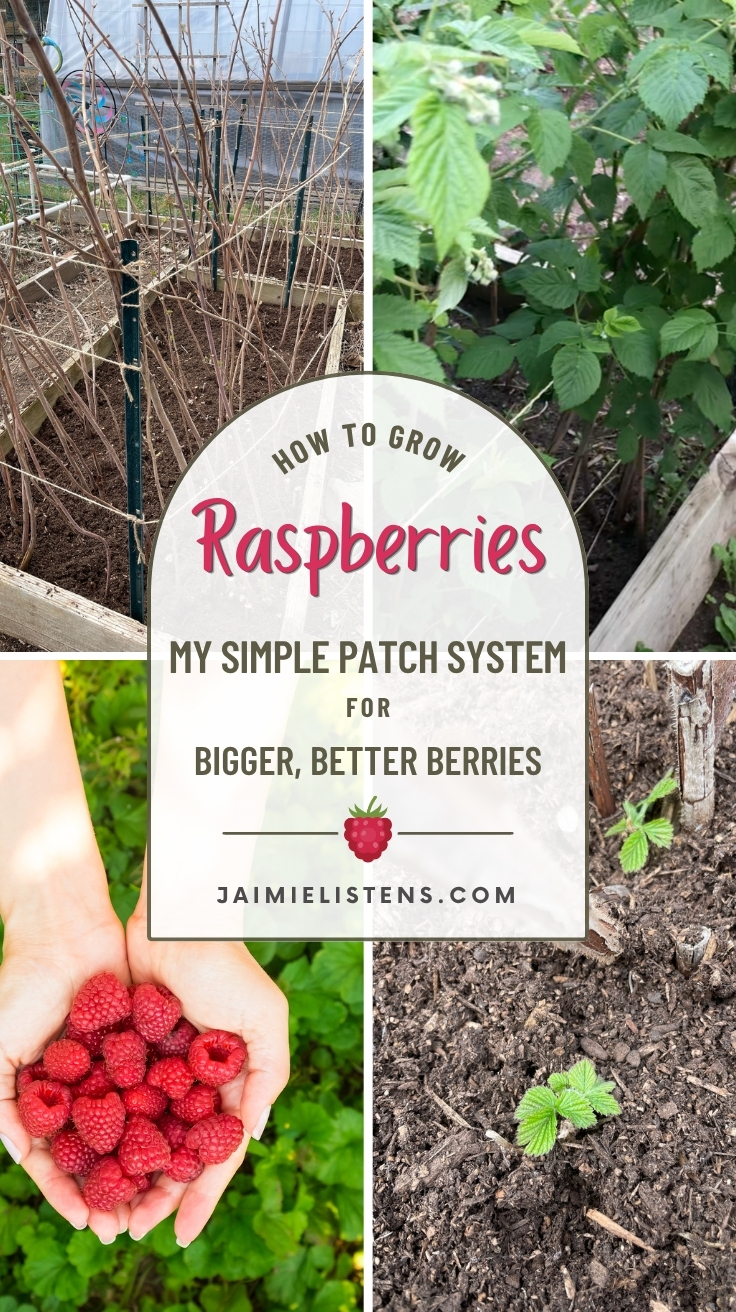
After years of messing with what works and what doesn’t, this is the order I stick to.
9 Easy Steps to Bigger, Better Raspberries:
- Let new canes grow through fall
Don’t cut them back too early. Let the plant fully develop and store energy. - Leave canes standing through winter
This gives the plant time to hold onto that stored energy. - Wait for early spring buds
Once you see buds forming, you know the plant has already “decided” how much energy it needs. - Remove old dead wood first
Clear everything out so you can actually see what you’re working with. - Cut canes back (waist to chest height)
This is where you redirect that stored energy into fewer, larger berries. - Tie canes to a trellis or support with string
Keeping them upright makes a big difference in airflow and ease of picking. - Thin to 2–3 strong canes per plant
Remove weak, skinny, and short late-growth canes so the plant can focus its energy. - Clean out debris at the base
This helps with airflow and overall plant health. - Add about an inch of compost
A simple layer of organic compost gives the plant what it needs to produce well.
That’s the full system. Simple, repeatable, and it works.
Raspberry Trellis Ideas That Keep Canes Upright and Easy to Pick
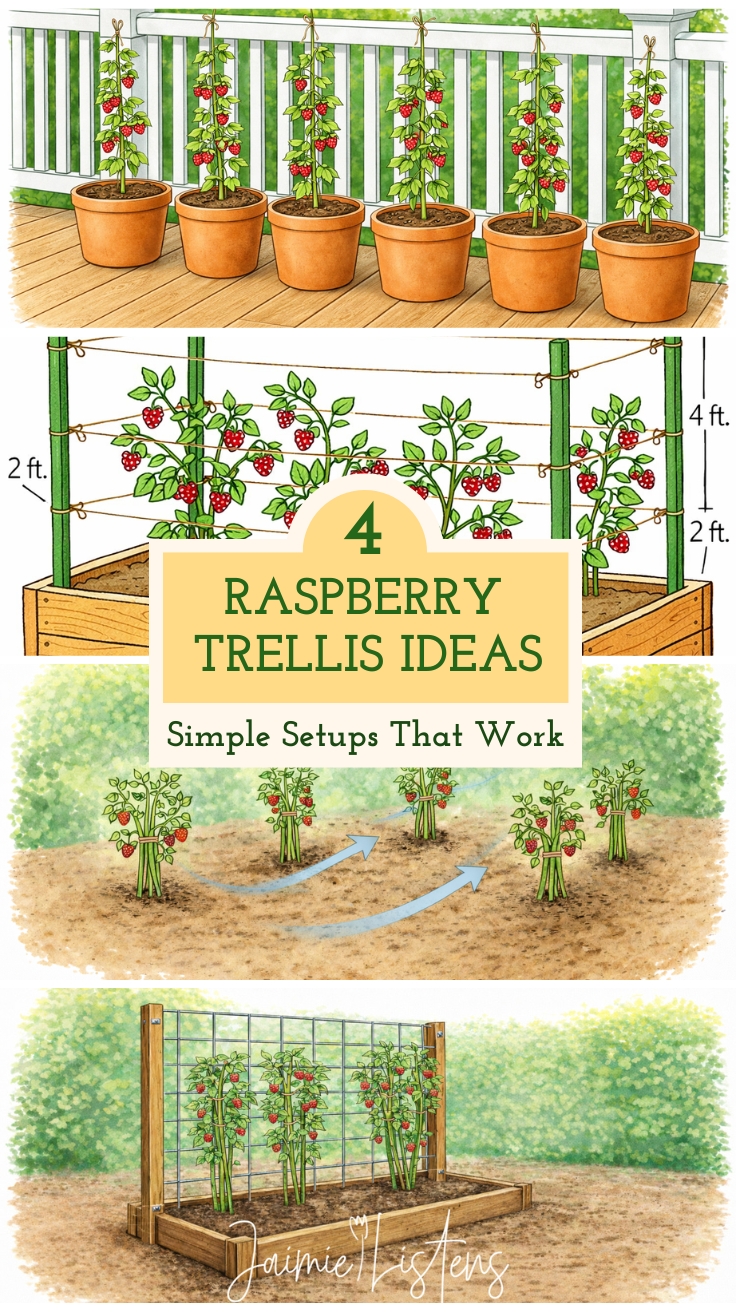
You don’t need a complicated setup to grow raspberries well. The goal is simple. Keep the canes upright, easy to reach, and not tangled together.
If you’re specifically looking for raspberry trellis ideas, these are the three setups that actually work in real life.
Here are a couple of simple raspberry trellis ideas that actually work in real life, plus one low-effort option if you don’t want to build anything.
Idea #1: Simple T-Post Trellis (My Go-To Setup)
This is what I use.
I buy the inexpensive green T-posts from the garden center. They’re sturdy, easy to move if I need to adjust my rows, and they already have notches and holes that help hold the twine in place.
I run jute twine between the posts and use it to guide the canes upright. It’s simple, it works, and I don’t have to fight with it.
Just make sure you drive the posts down far enough so that little back-arrow bottom is fully in the dirt. If it’s not set deep enough, the whole thing can shift once the plants get heavy.
Idea #2: Cattle Panel Trellis (Sturdy and Easy to Work With)
If you want something more structured, a cattle panel works really well.
The openings are large enough that you can easily reach in and pick your berries, and it gives you plenty of spots to tie canes exactly where you want them using twine.
For a simple setup, you can:
- use two 5-foot 2x4s as your side supports
- stabilize them at the base with shorter 2×4 pieces
- attach everything along the inside of a raised bed
Then staple the cattle panel to the 2x4s using heavy-duty U-shaped nails.
If you’re using a longer panel, make sure you add support in the middle so it doesn’t bow out. You can use additional wood posts or even green T-posts with zip ties to keep it solid.
I actually use this setup for my blackberries, and it holds up really well.
Idea #3: No-Trellis Method (If You Want to Keep It Simple)
If you don’t want to build anything, or don’t have the time or resources just yet, you can still grow raspberries without a trellis. Then, add what you want later as your patch grows.
The key is staying on top of pruning and thinning so the canes don’t fall over and turn into a tangled mess. It also helps to keep the canes shorter, since unsupported canes are more likely to break once they leaf out and catch the wind.
Keep your rows narrow, limit the number of canes per plant, and space things so air can move through. You can loosely group or tie canes together with jute twine to give them a little support without installing a full structure.
It takes a bit more attention, but it’s completely doable if you want to keep things simple.
Idea #4: Grow Raspberries in Pots (If You Have Limited Space)
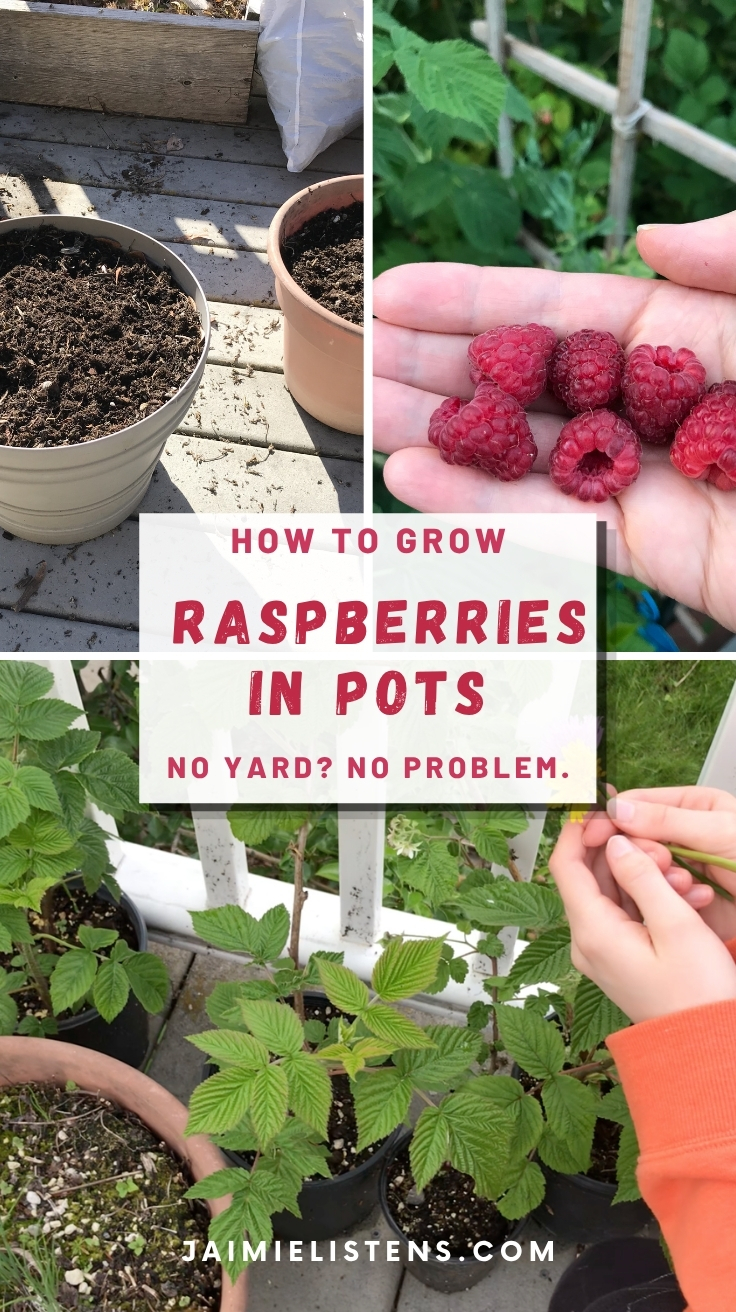
If you don’t have a yard, this is one of the easiest ways to grow raspberries successfully. I’ve done it year after year, and raspberries live in pots just fine.
If you want to get your raspberry fix but are in a temporary situation, or you have more patio than yard, you can successfully grow raspberries in pots.
What you need is several large pots, good compost-enriched soil to fill them with, and something to support the canes. Five-gallon buckets or planters work great. Larger pots are even better. An inexpensive option is to use large sturdy grow bags.
Simply grow your canes in the pots, then add a small trellis or even a sturdy wooden stake to tie them to. Plan on one plant per pot. If you’re using a 10-gallon or larger container, you can fit two. Even better if your deck has a railing – line ’em up and tie ’em up to it.
Make sure to fertilize twice for these babies. Once in early spring and again after fruiting is done for an extra boost. It’s also important to water more often, since the roots are above ground and the soil dries out faster.
The nice thing is, if you move, you can take them with you, and you don’t have to worry about digging out suckers.
Common Mistakes When Growing Raspberries That Lead to Small Fruit

Most raspberry problems don’t come from one big mistake. They come from a handful of small things that seem harmless on their own but work against you over time.
The frustrating part is, your plants can still look healthy while all of this is happening. You’ll get plenty of growth and even a lot of berries, but the fruit ends up smaller and harder to pick than it should be.
Once you know what to look for, these are easy to fix.
1. Letting Too Many Canes Grow
It’s easy to think more canes will give you more berries. It does—but they’re usually smaller.
When the plant spreads its energy across too many canes, it can’t support large fruit well. Thinning down to a few strong canes makes a noticeable difference.
2. Cutting Too Early or Not Cutting at All
Timing matters more than people realize.
If you cut canes back too early, the plant hasn’t stored much energy yet. If you don’t cut them back, that energy gets spread too thin.
Waiting until early spring, right when buds form, is what helps shift that energy into bigger berries.
3. Skipping Cleanup at the Base
Leaving dead wood and debris underneath the plants restricts airflow and makes everything harder to manage.
Cleaning out the base helps the plant stay healthier and makes it easier for you to see what you’re working with.
4. Not Feeding the Plant Enough
Raspberries can’t produce well if they don’t have what they need.
A simple layer of compost around the base goes a long way in supporting strong growth and better fruit.
5. Letting Canes Fall Over or Tangle
When canes aren’t supported, they flop over, crowd each other, and make harvesting more difficult.
A simple trellis or even basic support with twine keeps everything upright, improves airflow, and makes picking easier.
6. Ignoring Sunlight and Heat Conditions
Raspberries do best when they get good light without being blasted all day.
I’ve found they really like early morning sun, with some protection from the hottest part of the afternoon. Mine get morning sun, then filtered shade from a tall pine tree, a little more sun, and then shade again later in the day from my greenhouse and nearby bushes.
They still get plenty of light, but they’re not stressed by constant heat.
I’ve also noticed the berries come off easier in the evening than in the morning. It’s cooler, easier to see without the bright sun, and honestly just more pleasant to pick.
Most of the time, it’s not one big problem.
It’s a few small things working against you at the same time. Once you fix those, everything starts to improve pretty quickly.
Seasonal Guide: How to Grow Raspberries Using This Simple System

If you step back and look at the whole process, growing raspberries really comes down to a simple flow.
You’re not trying to control every little thing. You’re just guiding the plant at the right times.
Here’s what that looks like all together:
Fall
- Let new canes grow freely
- Don’t cut them back too early
- Allow the plant to build strength and store energy
Winter
- Leave canes standing
- No major work needed here
- Let the plant rest and hold onto that stored energy
Early Spring (Before Growth Takes Off)
- Wait until you see buds forming
- Remove old dead wood
- Cut canes back to waist to chest height
- Tie canes to your trellis or support system
- Thin down to 2–3 strong canes per plant
After Setup
- Clean out debris at the base
- Add about an inch of compost
- Make sure everything is upright and easy to access
Growing Season
- Water deeply and less often (bottom watering if possible)
- Pick berries often to keep the plant producing
- Watch for new shoots popping up where you don’t want them
- Dig up extra shoots and pot them up for friends so you can keep friends
When you follow this cycle, everything works together. The plant stays strong, the energy stays focused, and the harvest becomes a lot more manageable.
You’re not doing more work. You’re just doing the right work at the right time.
If You’re Overwhelmed, Start Here
If you only do one thing, do this:
Wait until your raspberry canes start budding in early spring, then cut them back.
That one step changes how the plant uses its energy, and it’s the easiest way to start getting bigger berries without overhauling everything else.
You can figure out trellising, thinning, and cleanup as you go. Start there, and you’ll already be ahead of where most people are.
How to Grow Raspberries Successfully (Simple Wrap-Up)
Growing raspberries doesn’t have to feel like a lot of work.
Once you understand how the plant uses its energy, everything starts to make more sense. You’re not trying to manage every little detail. You’re just guiding it at the right times and keeping things simple.
A few small changes can turn a frustrating harvest into one that actually feels worth it.
Picture This
You walk out to your raspberry patch.
The canes are upright. The rows are clean. The berries are big enough to grab without needing a magnifying glass.
You’re not fighting tangled branches or picking tiny fruit one by one.
You’re filling your bowl and heading back inside before you get too hot. Maybe even making some homemade jam if your family is behaving themselves.
And hopefully enjoying a little peace and quiet, unless someone’s yelling, “Hey lady! Hey, laaaady!” over the fence.

AI Disclosure: This post was created with the assistance of AI tools for brainstorming, editing, and organization, which helps me manage chronic pain and physical limitations during long writing sessions. All content is based on my real-life experience and is reviewed and edited by me. Some or all images in this post may be AI-generated for illustration and inspiration. Learn more about how I use AI here.
Disclaimer: Jaimie is not the great and powerful Wizard of Oz, a lawyer, a doctor, a veterinarian, or a CPA. Nothing you read in my blog is a substitute for professional advice and doing your own good research. Remember that just because someone has credentials doesn’t guarantee their advice is golden or perfect. Put your smart hat on and do your due diligence. Good luck!

Leave a Reply