

You start the month with a plan that honestly seems reasonable.
You know what bills are coming. You have a rough idea of groceries, gas, and the usual expenses. Maybe you even feel a little hopeful, like, “Okay, this month should be fine.”
And then somehow, halfway through the month, things already feel tight.
Not because you impulse-bought a llama. That would at least be obvious.
It’s usually the normal stuff.
An extra grocery run. Lunch at work because the morning went sideways. Coffee because you were tired and needed a tiny moment of joy. Something from Amazon that felt necessary at 9:47 p.m.
None of it feels dramatic when it happens, but then you look up and realize you’re over budget again.
And that is where it gets frustrating.
Because if you’re wondering, “Why do I keep going over budget every month?” the answer is usually not that you’re hopeless with money or need to become a completely different person.
Most of the time, the problem is simpler than that.
Your budget is built like a neat monthly plan, but your life happens in small daily decisions. And those little daily decisions add up fast when there isn’t a clear system helping you see them before they pile up.
So before you scrap your whole budget, shame-scroll through budgeting advice, or decide you’re just “bad with money,” let’s slow it down.
There’s probably a fix here.
And it may be a lot more doable than you think.
Why You’re Over Budget Halfway Through the Month
It usually doesn’t happen all at once.
You start the month with a plan that makes sense on paper, and for the first week or so, you’re mostly on track. Nothing feels out of control.
Then life starts doing what life does.
You’re tired, so you grab food instead of cooking. You run into the store for one thing and come out with five. Something small pops up that you didn’t think about when you made your budget.
Individually, none of it feels like a problem.
But those little decisions stack up faster than you expect, especially when you’re not checking in along the way.
So by the time you realize things feel tight, you’re already halfway through the month and wondering what happened.
It’s not that you blew your budget.
It’s that it slowly slipped without you noticing soon enough.
Why You Keep Going Over Budget Every Month
If this keeps happening, it’s really easy to assume the problem is you.
Like you just need more discipline, or you need to try harder next time.
But if you’re going over budget every month, it’s usually not about willpower.
It’s about the setup.
Most budgets are built as a clean monthly plan. You decide ahead of time what everything should look like, and then you try to follow it.
But real life doesn’t cooperate like that.
Your energy changes. Your schedule shifts. Things come up. You make decisions in the moment based on what’s happening that day, not what you wrote down two weeks ago.
So even if your budget makes sense at the start of the month, it can quietly stop matching your life as the month goes on.
And when your budget and your real life aren’t lining up, you’re almost guaranteed to go over.
Not because you failed.
Just because the system didn’t hold up the way you needed it to.
It’s Not Overspending — It’s How Your Budget Is Set Up

Going over budget looks like overspending.
Like you must have gone too far somewhere.
But most of the time, that’s not actually what’s happening.
It’s not that you’re wildly out of control. It’s that your budget is set up in a way that makes it really easy to drift without noticing.
You probably have broad categories like groceries, eating out, or “miscellaneous,” and a number next to each one.
That works… until it doesn’t.
Because those categories are where real life happens.
That’s where you’re making decisions when you’re tired, busy, or just trying to get through the day. And when there’s no structure inside those categories, it’s easy to keep spending without realizing how close you are to the limit.
So it’s not just about “spending less.”
It’s about having a setup that actually shows you what’s happening while it’s happening.
Once you have that, the overspending usually starts to calm down on its own.
You’re Budgeting Monthly… But Spending Daily

Most budgets are built around the month.
You sit down, look at your income, list out your expenses, and come up with numbers that are supposed to last until the end of the month.
On paper, it works.
But you don’t spend money once a month.
You spend it a little at a time, every single day.
Because in the moment, a $12 lunch or a $25 grocery stop doesn’t feel like a big deal. It doesn’t feel like something that’s going to push you over budget.
But those daily decisions add up faster than your brain expects, especially when you’re not seeing the running total in real time.
So you end up with a plan that only gets checked at the beginning and the end, and a whole bunch of spending happening in between with no real feedback.
And by the time you realize where you are, you’re already halfway through the month and feeling the pressure.
It’s not that your numbers were wrong.
It’s that your system wasn’t built for how you actually spend.
If you already know this is the cycle you’re stuck in and you want a simple way to sort it out, the No-Drama Budget Reset gives you a clear place to start:
If your budget has felt messy, discouraging, or hard to pin down, you are not the only one.
The good news is, this usually gets easier once you can see where the pressure is really coming from.
The Small Purchases That Quietly Push You Over Budget

It’s almost never one big thing that throws your budget off.
It’s the small, everyday stuff.
It’s not just the obvious impulse coffee stop to take some stress off.
It’s more like the extra grocery trip because you forgot something costing extra gas.
The “quick” stop at Target or Amazon that turns into a few more things than you planned. Or the one or two duplicate purchases because you forgot you already had the thing.
None of it feels dramatic in the moment.
And that’s exactly why it’s so easy to miss.
These purchases don’t set off alarm bells. They feel normal, justified, even necessary sometimes. You’re tired, or busy or both and you’re just trying to get through your day.
But when you zoom out, those small decisions are where a lot of your money is actually going. It stacks.
And if you don’t have a way to see them adding up as they happen, they quietly eat through your budget before you even realize it.
It’s not about cutting everything out.
It’s about being able to see those patterns early enough to do something about them.
And as far as the coffee is concerned, if it’s your one daily treat, gives you motivation for facing the world and keeps you from putting your boss in a head lock – that’s a good investment!
It’s all about doing things better and in a way that works for you, not against you.
Why Your Budget Doesn’t Match Real Life
A budget can look perfectly reasonable when things are calm.
Bills are listed. Grocery money has a number. Eating out has a number. The plan seems fine.
Then Tuesday happens.
Someone forgets lunch. The fridge contains three questionable leftovers and a bottle of ketchup. The car makes a noise. A bill is higher than expected. Dinner turns into takeout because everybody is tired and nobody has the emotional strength to discuss chicken again.
That’s real life.
And that’s where a lot of budgets fall apart.
They’re built for the neat version of the month, not the actual one with tired people, surprise expenses, forgotten errands, and convenience decisions.
So no, the answer is not always “be stricter.”
Sometimes the answer is building a little more honesty into the plan.
A budget that doesn’t make room for real life will keep making real life look like the problem.
The Expenses You Didn’t Plan For (But Always Show Up)

There are the obvious expenses.
Rent. Utilities. Insurance. Groceries. The things that show up every month and behave themselves.
And then there’s everything else.
The stuff that technically isn’t a surprise… but somehow still feels like one every time.
Oil changes. School things. Gifts. Something breaking in the house. That random “we need this now” purchase that wasn’t on the radar two days ago.
None of it is outrageous. Most of it is completely normal life.
It just doesn’t show up neatly once a month, so it gets left out of the plan.
And then when it does show up, it has to come from somewhere.
So the grocery budget gets stretched. Eating out creeps up. The “miscellaneous” category quietly absorbs everything until it’s doing way more work than it was ever meant to do.
This is where a lot of that mid-month pressure comes from.
Not one big mistake.
Just normal life showing up in places the budget didn’t make room for.
It only takes a short brainstorming session and review to factor in the known but often forgotten expenses. Take the yearly amount and spread it out by the month to give yourself a number to work with.
How to Stop Going Over Budget Without Starting Over

Once the budget feels off, the temptation is to throw the whole thing out and start fresh next month.
Very dramatic. Very understandable. Not always helpful.
Because starting over can turn into its own little trap. You keep waiting for a clean month, a normal week, a better paycheck, a time when nothing weird happens.
And please let me know when that magical month arrives, because I would like to visit.
The better move is to pause and make one small adjustment right where you are.
Look at what changed. Find the category causing the most pressure. Then choose one thing to shift.
Maybe that means easing back on takeout for the rest of the week. Maybe it means pausing Amazon. Maybe it means moving money from one category because something else became more important.
That is not failure.
That is budgeting.
A budget is not a perfect prediction. It is a plan that helps you maintain awareness and adjust when real life starts acting like real life.
A Simple Way to Fix Your Budget Mid-Month
When things feel off, it’s really easy to jump straight into fixing mode.
Cut everything. Lock it down. Try to “get back on track” as fast as possible.
That usually backfires.
Because when everything tightens at once, it stops feeling doable, and then nothing really sticks.
A simpler approach works better.
Start by just getting a clear snapshot of what’s actually going on. Not a full deep dive, not perfect numbers—just enough to see where things stand right now.
Then look for where the pressure is coming from. It’s usually one or two categories, not everything at once.
And from there, make one small move.
Not a full overhaul. Just one adjustment that makes things feel a little lighter for the rest of the month.
That’s the part most people skip, but it’s exactly what helps things settle down again.
It’s the same idea behind a quick reset. Step back, lower the noise, and give yourself a clear place to start instead of trying to fix everything at once .
You Don’t Need a New Budget — You Need This Instead
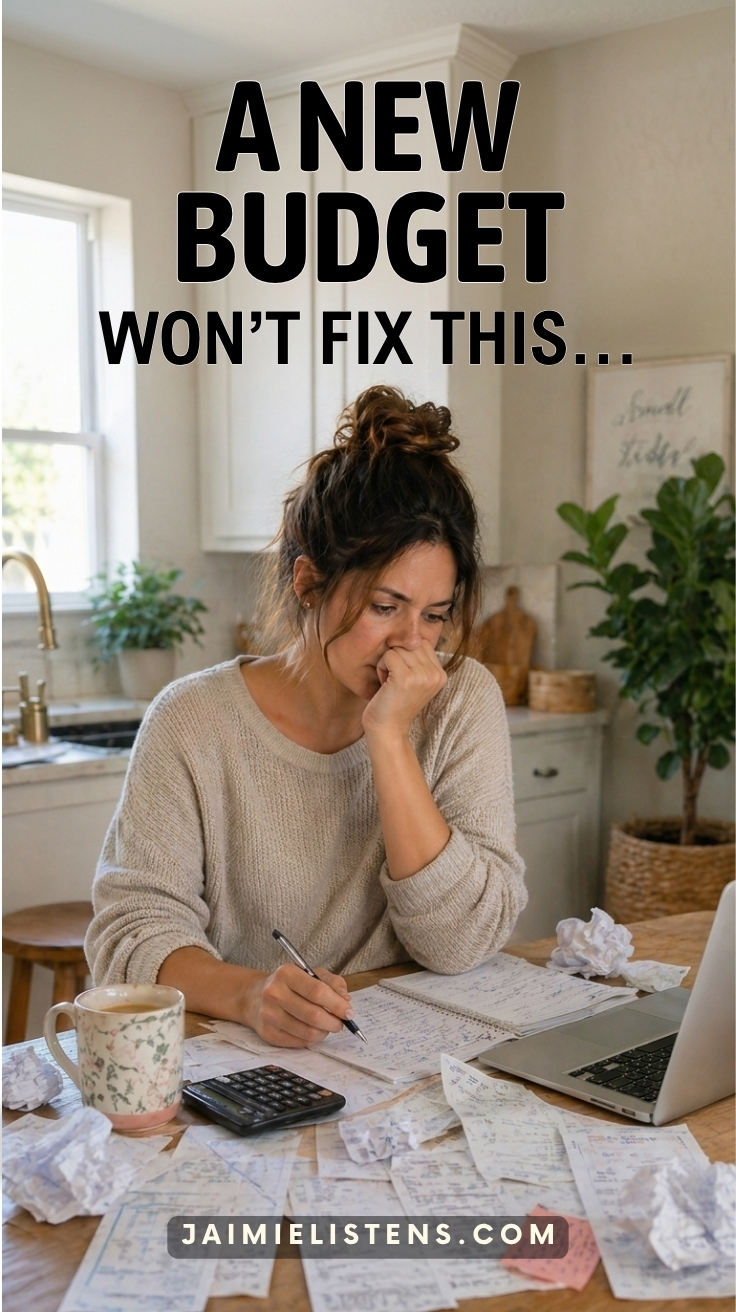
When a budget keeps falling apart, it’s tempting to assume the answer is a brand-new system.
New template. New app. New spreadsheet. New color-coded masterpiece that looks like your financial life got its own command center.
And listen, I love a good spreadsheet. And I’m not here to speak against office supplies and organized data, since I’m a firm believer in cute and useful office paraphernalia.
But most of the time, the problem is not that the budget needs to be prettier or more complicated.
The problem is that it needs to be easier to come back to.
You need a steady place to check in, see what changed, sort out the pressure points, and make the next reasonable move.
That’s it.
Not a money personality transplant.
Not a complete life overhaul.
Just a simple system you can actually use when the month gets messy, because it will get messy.
That’s not failure. That’s household life.
What to Do Next (So This Doesn’t Keep Happening Every Month)
At this point, the goal isn’t perfection.
It’s breaking the cycle.
That “middle of the month” feeling usually doesn’t come from one bad decision. It builds when you don’t have a clear picture or a simple way to adjust when things change.
Once things get clearer, the pressure starts to drop.
Not because everything is fixed, but because it finally makes sense.
That’s where things can shift.
Instead of guessing, reacting, or starting over every month, you have a steady place to come back to. A way to see what’s happening, sort out what matters, and make one small move at a time.
That’s the difference between a budget that looks good on paper and one that actually works in real life.
If you want a simple place to start that doesn’t feel overwhelming, that’s exactly what the No-Drama Budget Reset is designed for.
Just enough clarity to help you take one steady step instead of starting over again next month.
You can grab it here:
AI Disclosure: This post was created with the assistance of AI tools for brainstorming, editing, and organization, which helps me manage chronic pain and physical limitations during long writing sessions. All content is based on my real-life experience and is reviewed and edited by me. Some or all images in this post may be AI-generated for illustration and inspiration. Learn more about how I use AI here.
Disclaimer: Jaimie is not the great and powerful Wizard of Oz, a lawyer, a doctor, a veterinarian, or a CPA. Nothing you read in my blog is a substitute for professional advice and doing your own good research. Remember that just because someone has credentials doesn’t guarantee their advice is golden or perfect. Put your smart hat on and do your due diligence. Good luck!

Leave a Reply