

Paperwork piles don’t happen because you’re lazy.
They happen because most “filing systems” are basically cute junk drawers. Everything gets grouped by topic, and then you’re stuck with paper that never leaves because nothing has a clear ending.
Here’s the real issue: you’re storing papers together that have totally different lifespans and different levels of importance.
So I do it the opposite way. I start with the end in mind and ask one question that fixes almost everything:
What’s the exit strategy for this piece of paperwork?
The Home Document Organization System That Stops Paper Piles
I call it The 4×4 System: 4 buckets for today. 4 homes for the long haul. It starts with the end in mind so every piece of paperwork has a job, a place to land, and an exit strategy—before it ever becomes part of a permanent pile.
This system gives your paperwork a job and an ending, so it stops multiplying on your counter. It works because it separates what stage a paper is in right now from where it belongs long term. In other words, you use four buckets for today and four homes for the long haul.
The 4 Buckets That Keep Paper From Taking Over Your House

These buckets are not filing. They’re status labels.
They tell you what’s happening with a piece of paper right now, so you don’t accidentally bury something unfinished or let a “to-do” turn into a mystery stack.
Here are the four buckets:
#1 Inbox
This is your sorting station.
Think of it like your email inbox. The junk gets filtered out before it lands here. The trash can is your spam folder.
Your inbox is the stack that needs decisions.
#2 Action Items
This bucket is for anything that needs you to do something:
Pay it. Call about it. Fill it out. Scan it. Send it. Dispute it. Submit it. Deposit it.
Action is what you do, not where a paper lives forever. Once you take the action, the paper either goes back to Wait/Hold (if it’s still not finished) or it moves to To-Be-Filed (if it’s done).
#3 Wait/Hold
This bucket is for anything that isn’t finished yet.
A perfect example is medical paperwork. An Explanation of Benefits (EOB) goes in Wait/Hold while you’re waiting for the bill that matches it. If the bill doesn’t match the EOB, something’s wrong and it becomes an Action Item.
The rule is simple: it doesn’t leave Wait/Hold until it’s actually finished.
If you’re waiting on something specific, write a quick note right on the page (even in pencil) so Future You doesn’t have to re-figure out the story.
#4 To-Be-Filed
This is the “completed” stack.
It’s finished. You’re not waiting on them anymore. You’re just waiting on you to have time to shove it into the right home.
Label it this way if you want it crystal clear:
Completed. Ready to be filed in its Home.
The 4 Homes Where Paperwork Lives Until It Can Leave

Once something is completed and sitting in your To-Be-Filed stack, it needs a long-term home.
This is where most people get stuck, because they file by subject (medical, house, school) and accidentally mix papers that have totally different lifespans. That’s how “organized” folders turn into permanent storage.
Instead, you choose a home based on the paper’s exit strategy. Keep it as long as you have need for it… or as long as someone can clock you over the head with it later.
Here are the four homes:
#1 “Permanent” Home
These are your “do not lose” documents.
Birth certificates, Social Security cards, deeds, wills, adoption papers—things that are hard to replace and matter for life.
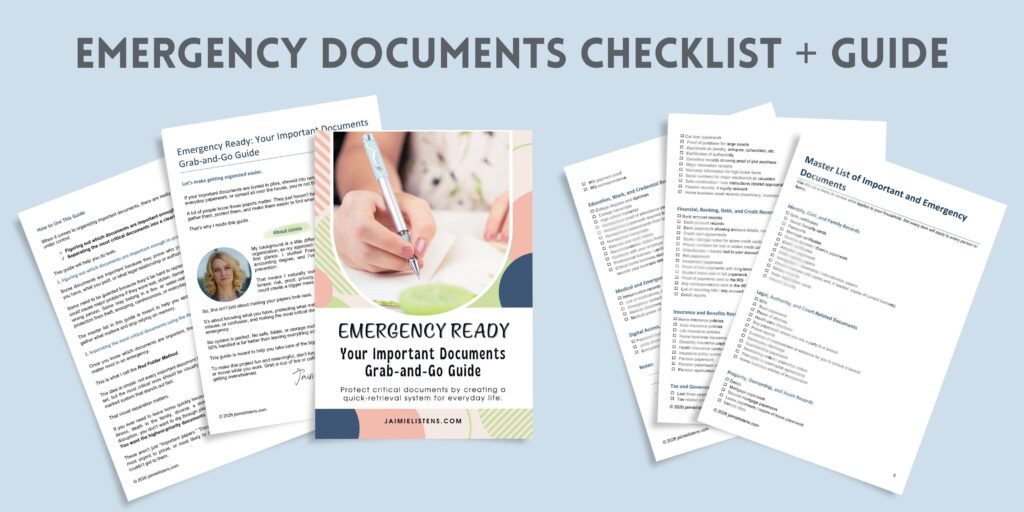
If you want a simple, printable checklist of exactly these “do not lose” documents so you can grab them fast in an emergency, I created one for you. It has a comprehensive list of documents so you don’t forget anything and a hierarchy for organizing them that eliminates guessing.
#2 “As Long As I Have It” Home
This paperwork exists because you own something.
Car paperwork. Appliance manuals and warranties. Insured furniture or valuables. Big purchase receipts that matter as long as you still have the item.
When the item leaves your life, the paperwork can leave too.
If receipts are your personal paper kryptonite, I wrote a whole separate post that gives them a job and a simple home so they stop becoming mystery stacks: Paperwork Organization: A Receipt System That Stops Piles.
#3 “As Long As It Can Bite Me in the A$$” Home
This is your protection folder.
Proof of debt payoff. Medical claims paperwork. Anything tied to a dispute, correction, or “oopsie” billing situation. If there’s a chance you’ll need to defend yourself later, it belongs here.
Think statute of limitations energy.
#4 “As Long As I Can Be Audited (Need or Want)” Home
This is the default home for most everyday paperwork.
It’s the “keep it for a while, then shred at the appropriate time” category. If you’re not sure where something goes, it usually goes here.
Choose How You File:
In your homes sections, you get to choose your own filing style, because it’s important to work with your brain flow – not against it. You don’t want to simply treat your homes like giant dumping boxes.
File stuff the way your brain finds things fastest: by category (banking, utilities, insurance, taxes) or by date (year/month). Or even group by like items. Pick one method and stay consistent—an imperfect system you’ll maintain beats a perfect one you avoid.
Option 1: File by category (subject)
This works best if you think, “That was a medical thing,” or “That was utilities.”
Examples: Banking, Credit Cards, Utilities, Insurance, Taxes, Pay Stubs.
Option 2: File by date (time flow)
This works best if you think, “That was two months ago,” or “That was last spring.”
Examples: By year, then month. Or one folder per year with everything in order.
Option 3: File by like items (similarities)
Use this if you don’t have a ton of paperwork and it would be silly to create 25 tiny categories. Perfect if your brain thinks in “groups” instead of exact subjects.
Examples: People records, medical paperwork, home + property, vehicles, work + income, money proof, taxes.
Pick the method you’ll actually maintain.
A slightly imperfect system you can stick with beats a “perfect” system you avoid.
How the 4×4 Home Document Organization System Flows in Real Life
This is the part that makes it feel easy instead of fussy.
You’re not “filing all day.” You’re just moving paper through a simple path, one decision at a time.
1) Filter junk before it hits your Inbox
Open mail over the trash can if you need to. The point is to keep obvious junk from ever becoming part of your system.
Trash is your spam folder.
2) Sort your Inbox into the other three buckets
Your Inbox is the stack that needs decisions. When you sort, you’re only answering one question:
What stage is this in right now?
- Needs you? → Action Items
- Not finished yet? → Wait/Hold
- Finished and ready to put away? → To-Be-Filed
3) Wait/Hold stays put until it’s actually finished
This is the rule that prevents missed bills, double payments, and “I swear I already handled this” stress.
Example: EOB goes into Wait/Hold while you’re waiting for the bill that matches it. When it matches, you pay it. If it doesn’t match, it becomes an Action Item.
And if you’re waiting on something, write a tiny note right on the paper so you don’t have to re-decipher the story later.
4) To-Be-Filed goes into the right Home
When you have time (weekly, biweekly, whenever your life allows), you take the completed “To-Be-Filed” stack and file it into one of the four homes:
- Permanent
- As Long As I Have It
- As Long As It Can Bite Me in the A$$
- As Long As I Can Be Audited (Need or Want)
5) Shred anything that doesn’t need to be filed
Not every piece of paper deserves a folder.
If it has no job, no risk, and no reason to exist, let it exit.
Why This Works When Cute Filing Systems Fail
Most home document organization advice skips the hard part: paper has a lifecycle.
So people build a “medical” folder, a “home” folder, a “taxes” folder… and then they shove everything in based on subject. It looks organized from the outside, but inside those folders you’ve mixed papers that should live for totally different lengths of time.
That’s how paperwork becomes permanent clutter.
The 4×4 System works because it separates two things most people mash together:
Paper’s current status
Is it unfinished? Waiting? Done? Needs action?
That’s what the four buckets handle. They keep you from burying something that isn’t resolved yet, and they keep your counter from turning into a mystery stack.
Paper’s long-term job
Does it need to be kept forever? Only while you own something? Only while it could come back to bite you? Only through an audit window?
That’s what the four homes handle.
Once you separate status from long-term storage, everything gets easier to maintain because you’re no longer trying to force every piece of paper into one “perfect” category system.
You’re just giving it an ending.
When you organize paperwork by exit strategy, cleanup gets easier too. When it’s time to purge, you’re not digging through mixed categories trying to guess what’s safe to shred. You can review one home at a time, remove what’s expired, and keep what still has a job.
It’s faster, it’s calmer, and you’re way less likely to accidentally toss something that needs to be kept longer because papers with similar lifespans are stored together on purpose.
Picture This: A Clean and Clutter-Free Work Space

You grab the mail and toss the junk before it touches your counter.
The real papers go into your Inbox stack, not in random piles across the kitchen like they pay rent there.
Later, you do a quick sort:
- You put anything urgent into Action Items.
- You drop anything unfinished into Wait/Hold (and you jot a tiny note on it if you’re waiting for something specific).
- You slide anything finished into To-Be-Filed.
That’s it. No drama.
On filing day, you grab the To-Be-Filed stack and give each paper a Home. Most of it lands in As Long As I Can Be Audited, and the rest goes where it belongs. You shred anything that doesn’t deserve a folder.
And here’s the best part: your system stays small.
Because paper doesn’t get to move in permanently anymore.
Now that you’ve got the 4×4 system in place, don’t overcomplicate the next part.
For now, use the simple rule: keep paperwork as long as you need it… or as long as someone could clock you over the head with it later. Then shred at the appropriate time.
And yes, “appropriate time” can get a little hairy, especially with receipts and tax-related stuff—so I’m breaking that out into its own post next: Important Documents Organization: What to Keep (and Why It Matters More Than You Think).
Now that you have the 4×4 system framework, make sure to grab my free Emergency Ready: Your Important Documents Grab-and-Go Guide and Checklist. It will help ensure your most critical papers are always ready to go, so there’s less panic and confusion when you really need to locate something fast.

AI Disclosure: This post was created with the assistance of AI tools for brainstorming, editing, and organization, which helps me manage chronic pain and physical limitations during long writing sessions. All content is based on my real-life experience and is reviewed and edited by me. Some or all images in this post may be AI-generated for illustration and inspiration. Learn more about how I use AI here.
Disclaimer: Jaimie is not the great and powerful Wizard of Oz, a lawyer, a doctor, a veterinarian, or a CPA. Nothing you read in my blog is a substitute for professional advice and doing your own good research. Remember that just because someone has credentials doesn’t guarantee their advice is golden or perfect. Put your smart hat on and do your due diligence. Good luck!

Leave a Reply